Friday, April 6, 2012

UH-OH!


It's that moment in time when you realize that you made a mistake. That particular instance when you just close your eyes, hold your breath, and hope that it would not be as bad as it looks right now.


It feels like air just popped out of the balloon and ... then you feel like as if your heart dropped to your knees. Time stood still and you are caught inside the Time Travel machine that's teetering precariously on the side of the cliff. Or like when you're on a run-away roller-coaster and you just know there's a steep drop at the end.


It could also be when you find yourself in an awkward situation, and all you can do is hope that you don't get hit by an errant fist.

It's that particular instance when you just mutter a curse under your breath, and just wish that you ignored that annoying alarm clock and just slept through it all.

It's an" Uh-Oh" moment... synonymous to "Ooops", "Oh, No", "OMG", and in a more direct-to-the-point colloquial "Patay kang bata ka".


"Sige na, Day". "Sige na" Loosely translated, it means "So long" "Arrividerci", "Adios".
"Day" is a common Cebuano nickname. Totally harmless?

A patient's family member tearfully approached the Nursing Station and asked the Head Nurse, "I thought my mom is doing well but I keep on hearing the nurses say that she is going to die."

At that point, the outgoing nurse waved at the her friend and cheerfully (and loudly) said, "Sige na , Day"
Uh-oh!


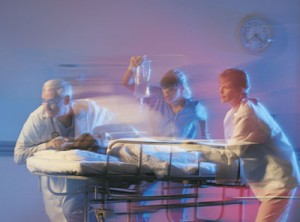
The female accident patient lay strapped on the backboard with a cervical collar. The nurse cuts the patient's winter coat and the down feathers flew into the air around the Trauma Room.

The feathers getting into our faces and hair, into little crevices, nooks, and crannies. Into the Trauma Chief's nose as he glared at you but could not take out the offending feather because he was all gloved up.


Uh-oh!


It was change of shift at the Trauma Room, and the in-coming nurse just couldn't tolerate a messy room. She threw out a yellow basin filled with dirty pads that was sitting on the stretcher. The housekeeping guy followed after to empty the garbage.

Then the triage nurse came back to the room to finish her documentation. Suddenly, she sat straight up in her chair and screamed, "The finger! Where is the finger?"

The patient 's index finger was accidentally amputated - man vs. meat grinder- and the moist-gauze soaked finger in a bag of ice that EMS had deposited on the patient's stretcher was nowhere to be found. That finger is supposed to be reunited to the patient via microvascular reimplantation. That is, if they could find the finger.

Two nurses bolted out of the room running after the housekeeper.

Uh-oh!

Thankfully, the finger was found after the second garbage search.


The patient's visitor was obviously his gay lover. The patient presented with severe chest pains after "an extremely long aerobic exercise".
Another nurse brought in a female visitor.
"You have another visitor, sir. " The nurse turned to the visitor, "Are you his sister?"
"No, I'm his wife. And who is this man holding my husband's hand?"
Uh-oh!


The four-year old girl broke into a smile when she saw the glove balloon that a nurse's aide made for her. Her mother came in with abdominal pains, but did not have anyone to watch the child. The father was just on his way to the hospital. The nurse's aide was assigned to watch the child until then.


The string of the balloon flew away, and before the obese nurse aide could get up from her chair, Baby Jessica started to chase after the flying balloon. Off she went in-between the double-parked stretchers in the hallway, barely missing bumping into anything, or being squashed by a passing stretcher.


Uh-oh!


http://nurses.definitelyfilipino.com/index.php/2012/04/uh-oh/

Saturday, February 18, 2012

A Date with Mr. Smith

I had a date with Mr. Smith today. But he would not be going anywhere.

Mr. Smith laid on the bed surrounded by his nurses. The Normal Saline IV on his left arm was just to keep the vein open. His eyes stared unseeingly but his eyes blinked. A thin sheen of moisture on his waxy face suggested diaphoresis. The nurse looked at the cardiac monitor and her face showed concern at the tachycardia and the hypotension.

“His radial pulse is bounding. Heart rate is 126, BP 90/70″, she reported to the other nurses at the bedside.

Mr. Smith’s lips did not move but a disembodied voice startled the other nurse who was listening at his lungs. He said, “ It feels like an elephant is sitting on my chest”.

Nurse 1 changed Mr. Smith’s nasal cannula to a 100% non-rebreather mask to raise his oxygen saturation from the 92% displayed on the cardiac monitor. She raised the head of the bed and asked the patient care technician to do a stat EKG. The nurse looked around and caught my eyes. I knew what she wanted so I reassured her that I called for the doctor already.

Nurse 2 reported that he heard rales 1/3 up bilaterally. Both nurses exchanged a worried look. The outgoing nurse tried to finish her report. “Mr. Smith just came to the ED one hour ago complaining of shortness of breath for several days exacerbated by walking up the stairs. This morning, he woke up feeling he was drowning with his secretions. Chest x-ray showed bilateral pneumonia. We got him his Lasix 40 mg already.”

The foley catheter bag on the side of the bed was draining with 300 ml of amber-colored urine. Lasix urine, I thought.

Nurse 1 said, “Uh-oh, his BP is going down. Where’s the doctor ?”.

The patient stopped talking. Nurse 1 darted a look behind her at the unexpected turn of events. “Mr. Smith, are you okay?” . The cardiac monitor displayed ventricular fibrillation. There was just a second hesitation when the nurses processed what they were seeing on the machine, but soon their ACLS training went into gear.

Nurse 2 felt for the carotid pulse. “No pulse”. The outgoing nurse stopped her report, and started her compressions. But she had to stop for a few seconds as she grabbed a stepstool from the other side of the room.

There was a slight tremor in the Nurse 2′s voice but he pulled himself together and, after making sure that everyone cleared off the patient, quickly delivered a defibrillation shock on the patient. He reported later that it felt empowering to press on the paddles and deliver the shock that his patient needed.

“Still no pulse”. The other two nurses resumed CPR; one nurse doing compression on Mr. Smith, while the other nurse pushed air through the ambubag. Thirty compressions, two breaths.

The doctor came in and the first nurse gave a quick report. Dr. Morris had not even given the order yet, but the nurse handed her an Epinephrine, clearly anticipating the first drug on the ACLS algorithm. Dr. Morris was a second-year ED resident and this is her first code. The attending physician was busy with another code in the other room.

Dr. Morris took a deep breath, but she knew that the other nurses had worked in the ED for a long time. The code continued with the veteran nurses basically suggesting the next step to the doctor who just happily agreed with all their suggestions.

The patient was their focus and the team members worked as hard as they’ve always done. After the initial confusion, the team had settled down and continued with the ventricular fibrillation algorithm.

After another cycle of defibrillation, compressions, and drugs, a pulse check revealed a strong pulse. The cardiac monitor showed Normal Sinus Rhythm. The blood pressure was still low, so upon the nurse’s suggestion, Dr. Morris ordered a Dopamine drip.

Mr. Smith opened his eyes and spoke again, “Hello there”. Everybody smiled. And applauded that they survived Simulation.


End of Simulation. Start of Debriefing.

I stepped behind the one-way mirror of the control room. My students stood around Mr. Smith in the room that was outfitted like a state-of-the-art ED room. I led the group into the Debriefing Room.

That was my date with Mr. Smith. He’s our new hi-fidelity human patient simulator, our newest toy in nursing education.

Mr. Smith is the high-fidelity sim-manikin that we’re using in my hospital. He can pretty much do anything else, well, almost anything. He’s an interactive manikin specifically designed for training in anesthesia, respiratory and critical care. He is capable of realistic physiologic responses, including respiration, pulses, heart sounds, breath sounds, urinary output, and pupil reaction.

Simulation training in nursing education had established itself as an effective teaching strategy. It allows the students to be involved in patient care experiences, with the use of simulation manikins, where they can practice clinical skills and demonstrate their critical thinking abilities in a safe environment. Simulation learning also permits learning team work and good communication among the different disciplines who are involved in patient care.

The Debriefing is where we reflect on the just-concluded simulated case scenario. The students reflect on their feelings, and their performance during the scenario. I reviewed with them key points in the scenario, putting emphasis on successful performance of expected skills.

The nurses enjoyed their first date with Mr. Smith. I told them that we will be introducing more case scenarios with Mr. Smith. COOL.


http://www.meti.com/products_ps_hps.htm
Key Features:
1. Pupils that automatically dilate and constrict in response to light
2. Thumb twitch in response to a peripheral nerve stimulator
3. Automatic recognition and response to administered drugs and drug dosages
4. Variable lung compliance and airways resistance
5. Automatic response to needle decompression of a tension pneumothorax, chest tube drainage and pericardiocentesis
6. Automatic control of urine output

Saturday, October 29, 2011

Top Five Things I Love as an ER Nurse


I love being an ER nurse. I got into Nursing because my family wanted me to. I was one of the lucky ones who actually learned to love being a nurse and to love the profession even after 20 years of ER nursing. Nursing in the USA had given me great financial rewards and had allowed me to help my family at home.

But, I would not have remained a nurse if I was miserable in this job. So I find it annoying when I read about too many complaints and regrets about the profession. Whenever I read anybody bashing Nursing, my first question had always been: “Why stay any longer?”

Some nurses vent their frustrations (understandable) of not finding a job after nursing school and of their righteous indignation at being exploited as "paying" volunteers (total contraindications). Nurses in the Philippines deserve recognition for their service despite the "horrendous" situations in most of our hospitals.

Some nurses may actually find out that they don’t like being a nurse. That’s fine; that’s perfectly acceptable. Not everyone is suited to be a nurse. They may be perfectly decent and compassionate people, but Nursing may not be for them, period.

But please do us a favor: just leave nursing to those of us who’ve found a niche in whatever field we’re in. Do not enumerate all the reasons for your disillusionment, because by doing so, you are merely mocking the profession that had actually brought happiness and fulfillment to most of us.

Have you finally realized that you'd rather be anyone else but a nurse? Then, just GO! Take a deep breath and move on to whatever your heart desires. Follow your non-nursing dreams. Make your choice and don’t drag down your fellow nurses with your negative vibes.


Life is challenging enough to be working alongside a person who does not share the passion. It is a disservice to the patient if we stay for the wrong reasons. The patients deserve nurses with service in their hearts; who care for them because they love to and not because they love the money or because they were “forced” to. If I were a patient, I would not want a nurse who thinks only of her overtime money and who could care less if I need any pain medication.

We’ve come into Nursing with our eyes wide open. Our parents must have nudged us with visions of jobs abroad but I doubt it if they promised us a rose garden. Nursing is hard work and entails many sacrifices. It meant that my life would not be as glamorous as if in show business but I rolled up my sleeves and got to work. I accepted that the uniform does not pave the way for a life in the limelight, of high fashion and easy money.

For once, I was too brusque to a nurse who whined about all sorts of things. I turned to her, and asked, “Then, why are you still here?”. I realized later that she was burned out, but I just did not want to be sucked into her miserable existence. The negativity was burning a hole in her personality it was torture to have her around.

After all these years as an ER nurse, one would expect a sense of disillusionment or burnout. But instead of waning, my passion for emergency nursing is burning in its intensity. When you find the nursing field that you’ve been looking for, any other department is inconceivable. And I realized, it is a double blessing when you enjoy the work you do. Nurses make a difference.

Here are the top five things that I love as an ER nurse:


1. Variety is the spice of life- No two days are the same. There is no such thing as Ground Hog Day. But there are many instances of deja vu. It’s like a different flavored ice cream every day.

A staff nurse has different assignments and sometimes can be switched to different positions in a single shift. Every single day is an adventure, sometimes overwhelming but never boring.

You never know what will come through the ambulance doors. It is when it is too quiet that we scratch our heads and our hearts flutter because surely, something dramatic will come. We should always prepare for the unexpected. We should always be on our toes; this is not a place for the faint-hearted.

One day, a small dog wandered over to the ER with a splinter on his paw. Another day, a woman protested too much, “I’m not pregnant. I’m just fat.” Moments later, she squealed, and out came a baby.

2. Organized Chaos – The ED is always overcrowded and it is gridlock time. Grand Central Parkway at 5pm. Stretchers are next to each other. Any floor nurse who visits the ED would be horrified at what they perceive as a chaotic environment. An ER nurse knows that although the activity level is frantic, the staff knows what to do.

And there is organization amidst the din; there is controlled chaos. The adrenaline rush sustains the nurse as she flies from one patient to another; her focused and determined look means that she’s managing her time as best as she can, so please get out of her@%&*@ way.

3. Interesting Patients/ Funny moments- A nurse will never run out of amusing stories to tell.

After a snow blizzard, EMS transported a patient using a snow sled. An inebriated man pushed his compadre to the ED on a grocery shopping cart and told the nurse stoically, “my friend needs help.”

A trauma patient came in after a motorbike accident with a fractured leg; he was totally covered with tattoos. His eyebrows, nostrils, and lips were pierced. His genitals were covered with his brand of art. But when he saw the 14 gauge angiocath, he screamed in fear.


A clergyman came after a freak accident with a cucumber lodged where it doesn’t shine. We keep a running tab on what’s the weirdest thing we found in any body cavity. Such is the life of an ER nurse. We live for the simple pleasures.

4. Inspiring people-
I get inspired by colleagues who lead by example: they spend their vacations on charity missions abroad. They spend their own money to go to Haiti or Guatemala. They come back with appreciation for their ability to touch lives.

And then there’s this nurse who worked cheerfully while struggling with a brain tumor. Her patients never knew that the nurse who comforted them needed comforting herself. But she persevered and gave her patients her very best.

There's another emergency nurse hero who continues to astound her army of supporters with her incredible determination as she fights for her life against the Big C.

Several of my fellow nurses were stuck inside the hospital when the blizzard rendered all roads impassable; they gamely took care of the patients. Some of us trudged through snow banks that were taller than us just so that we can relieve those who have worked before us. They’re our family.

5. Emotional rewards- It might sound too corny to some, but it is rejuvenating to see that you’ve made a difference.

Let me count the ways: you correctly triaged a patient with altered mental status as hypoglycemic; you assisted a battered woman find shelter away from her abusive husband; you monitored your stroke patient’s vital signs and now he thanks you for your help. You found the time to listen to your elderly patient who missed her loved ones who never visit. You helped deliver a baby.

We may not always get a Thank You, but when a patient gets better because of you, that’s good enough for me. That should earn us points in heaven.

I’m counting my blessings. I enjoy my work. I am an ER nurse.


Monday, August 8, 2011

The Great Escape


Tim slowly opened his eyes when he heard the door close. His pretend snores must have convinced the nurses to leave him be. He heard one nurse remind the other not to tie his wrist restraints to the bed side rails but to the metal support under the stretcher. This time, they left his boxers and socks on, and his feet unrestrained. Since he is an ER regular who loves his beer too much, he finally caught on to why the nurses always dressed him up with the "green gown". It was meant as a signal to all that he is an escape risk.

I need to leave. I need to escape, Tim muttered this to himself like a mantra.

Earlier, his cute nurse fiddled with the EKG leads on his chest and the heart monitor beeped with the now-familiar rhythm. She looked young and naive; her look of concentration as she applied the restraints belied her nervousness as she tried to imitate the confident efficiency of her preceptor.

"You must be new here, aren't you?" . Tim loved it when the newbies flinched as he growled and trashed in his bed. They quivered in fear, probably debating how long they would stay in the profession. Sometimes, when he is in the mood, Tim would put on a tantrum, his language as colorful as befitted the occasion (and most especially when the hospital police are nowhere to be seen). But there's another nurse named Josette who looks so sweet but could really shock you with her colorful string of curses.

Of course, he needs to maintain his reputation as the Obnoxious Drunk. The louder he is, the more the newbies scramble to give him extra helping of sandwiches and apple juice. On a really good day, he gets a hot meal during dinner time, then gets another one after a shift change.

Hahaha. This ER is so much fun. That's why he did not mind when the EMS used to bypass another private hospital to drop him off to his favorite city hospital. Here, everybody knows his name.

The senior nurses already know his modus operandi. While a junior nurse would try to cajole him into submission by giving him food, the senior nurses just raise their eyebrows at him, and quietly display the cloth restraints out. Those tough girls would not hesitate to slap a four-point restraints on him at a moment's notice. These nurses mean business, especially that night nurse named Tina. One look from her and he shuts up. They've come to an understanding: if he calms down and just sleep off his intoxication, she would leave him alone and she might even give him a cup of Colombian coffee that her Juan Valdez- look alike boyfriend brings her.

The "Banana bag" was infusing through his left arm vein. For some inexplicable reason, nurse Jackie (no, not that one on TV) had taken a liking on him. One night, while she was cleaning off a laceration on his hand, she started to educate him about the multivitamins in his intravenous. Now, he knows that the "banana bag" means he's well-nourished.

I got to go. My friend Dolly is waiting for me in the park with the Chivas Regal that she claimed that her boyfriend Frank gave her.

Tim looked up and found his salvation.

A hole in the ceiling. Yes!!! All that he had to do is get out of his restraints, retrieve the clothes bag under his stretcher and run for his freedom. But he needed to go up the ceiling because his jailor Tina would surely catch him if he tries to sneak out from the waiting room.

Tim flexed his hands. How smart of him to rub petroleum jelly on his hands just before the police picked him up from the street. He's not known as Houdini for nothing. Just a couple of tugs and he got out of his restraints. Next, he pulled out the intravenous on his arm just like how the nurses did.

Uh-oh, no time to dress up. He saw one of the doctors coming to his room, but thankfully, she was sidetracked in deep conversation with another nurse.

It's now or never. Tim stood up on the stretcher and started to climb up through the hole in the ceiling. Darkness awaited him but Freedom was within reach. He lifted himself up on shaky legs but he felt the green gown rip on a nail stud. Unbelievable, he was stuck! His legs were dangling in the air and his much-maligned derriere was in full display when Dr. S came through the door.

"Gotcha!"


* The names had been changed to protect the innocents (wink).

Tuesday, June 7, 2011

Till We Meet Again


What a journey it has been.

I said I will only be staying for two years. Like all others before me, I stayed longer and now it took twenty-one years for me to leave this place that I have grown to love. Elmhurst grabbed my heart and refused to let go.

It is a lifetime of memories. Through the years, we've created a kaleidoscope of special moments and bonded with a team of nurses, doctors, and support staff. Together, we've pulled through stressful times of overwhelming patient volume, poor staffing and personal differences.

I looked around the ED and marveled at the changes in the landscape, both in the physical environment and in the personnel who staff the ED day and night. The ED had changed but what remains true is that we are entrusted the responsibility of caring for others who are more vulnerable and unfortunate than us. To be able to spend your life in service of others is a blessing.

I started as a novice ED nurse who trembled every time I heard the red EMS notification phone ring and evolved to be a confident and knowledgeable nurse due to my multi-faceted Elmhurst experience. What's more important to me is the knowledge that I have made a difference.

Thank you for being a part of my journey. I will forever treasure the shared reminiscences and your kind words and expressions of support. It makes me happy to be appreciated by those who matter.

And now it is time to explore the world beyond these four walls and to create more memories in another hospital as their new clinical nurse specialist. Although I will be leaving a piece of my heart, I know that this new road will bring new opportunities for professional growth for me. If I made it here, I can make it anywhere.

To paraphrase Oprah, No sadness from me, I look forward to the next chapter in my life.

And when our paths will cross again, I expect to get a tight hug from you. Till we meet again.


Sunday, April 10, 2011

The Mule


Revised version as it appears in Nursing 2012, November 2012 edition.


1993, New York.

The elderly Filipino woman was shaking when she was brought by the EMS paramedic to Triage. She clutched my hand, pleading in silence.

The EMS paramedic bypassed the other triage nurse and zeroed in on me, correctly guessing that his patient and I share the same ethnicity.

“We picked her up at the airport,” he told me. “Her plane had just arrived fromBrazil. The flight attendants noticed that she was very agitated and crying uncontrollably. It seems she’s traveling alone, but she won’t talk to us.”

Anybody’s grandma

She was in her late 60s, with gray hair and a stooped posture; she looked like anybody’s grandma. In fact, she looked a lot like my own departed grandma. She held tightly to her purse and her eyes filled with tears. My initial reaction was to pat her shoulder in a gesture of comfort. As I rubbed her back, I felt her tremble.

At that moment, two men in suits appeared and handcuffed “Grandma” to the stretcher. The narcotics agents informed us that she was suspected of swallowing condoms of cocaine and she had to be isolated from the general population. They planned to wait for her to pass the condoms. I hoped that the cocaine packets would remain intact. Rupture of the packets would result in severe intoxication, seizures, and death.

Her story was all too familiar. She was a drug courier—or, in the colloquial term, a “drug mule.” But she was much older than the couriers who’d come to our ED in the past. None of the other couriers I’d seen looked like “Grandma.”

In my naiveté, I wasn’t prepared to think of the possibility of my patient as a drug mule. As I looked at her in disbelief and disappointment, she averted her eyes. Thrown off by my preconceived notions of what a drug mule should look like, I couldn’t help but ask, “Why?” She kept her eyes closed, but tears ran down her cheeks.

The agents were frustrated with the lack of information. “We need to find the people who contracted her to carry the drugs,” they told me. Their interviews with the patient were met with silence. She looked afraid; she provided all the demographic data for the registrar but refused to give any contact information. Maybe she didn’t want to give any information for fear of repercussions.

Taking a turn for the worse

Suddenly she grimaced in pain as she pressed on her stomach with her free hand. Alarmed, I yelled for the physician STAT. The patient’s BP was rising and her heart rate was racing. I was afraid that the cocaine packets had burst inside her.

“How many packets did you swallow? Tell us, please!” The patient hesitated, but as she squirmed in pain again, she mumbled, “Ten.”

The next few minutes were frantic as we prepared to send her to the OR for exploratory surgery. We were racing against time.

As she was wheeled out of the room, she turned to me and said, “I did it for my family.”

No room for preconceptions

“Grandma” didn’t survive the surgery. As we later learned, she died because she needed money to pay for her daughter’s cancer treatment back home.

Although we’d expected it, the news of her death affected the ED nurses who knew about her story. Our stereotypical image of a drug mule shattered, we were also touched by her sacrifice for her daughter.

To what extent would you go to help a loved one? we asked ourselves. How tragic that our patient felt trapped by her circumstances and fell prey to the drug lords who took advantage of her need.

I learned an important lesson that day: No patient is stereotypical; as unique as we all are, we respond differently to the chaos in our lives. There’s no place for preconceptions in nursing. We should be able to rise above our personal feelings and take care of each patient the best we know how, without passing judgment.


Sunday, April 3, 2011

My Favorite Things in the ER


I said I will only be staying for two years. Either I am a glutton for punishment, or just have an insatiable lust for adrenaline rush, or I really do love the ER. Twenty years later, the ER had taken a stronghold on me and I would never ever think of going anywhere else.


These are my favorite things:

1. EXCITEMENT GALORE- Nothing boring about ER. Every day offers something new and surprising, or out of this world. Days pass quickly, and however we try to manage our time, there's always something that needs to be done (including a bathroom break).


2. QUIET INTERLUDES, although infrequent, and temporary, are greatly appreciated and much-needed after a hectic day. Empty stretchers in the hallway are a welcome sight. This precious respite from the usual bombardment of patients allows time to sneak to the bathroom, catch up on each others' lives, and the chance to spend more time with our patients. Grab the moment to breathe because it means that a busload of patients are coming soon to break the peace.


3. HAPPY DRUNKS make up for the aggravation of having to fight off the nasty drunks. One day, a happy drunk masqueraded like a Luciano Pavarotti. His booming and impassioned O Sole Mio was surprisingly well-modulated and brought a smile to everyone, including our Alzheimer's patient, who stopped squirming in his stretcher. Somehow the familiar melody broke through the cobwebs of his mind, and he joined our happy drunk in total harmony.


4. LIVES SAVED We lose some, but most of the time we snatch patients from the brink of death. A 17-year old patient should have been a vegetable after a cardiac arrest, but we cooled him down and saved his brain. Five days later, he walked out of the hospital with full neurological functioning, ready to plan dates with his girlfriend again.


5. A SOILED METS CAP. A 9-year old boy felled by a direct blow on his chest from a baseball. He recovered from Commotio Cordis and came back to the ED to thank the staff. Pedro was in full Mets uniform, his blood-stained Mets baseball cap clutched in his tiny hands.


6. THANK YOUS.- A hurried discharge from a harried doctor left a patient and her family bewildered and frustrated. I spent just a few minutes to explain the discharge instructions. And I got a hug and a sincere thank you.


7. BULGING VEINS. Nurses always have a euphoric response to bulging veins, the ones which bulge before you even apply a tourniquet. No 22-gauge angiocathethers, no need for a vein probe, no need to call our vein expert. Just that quick pop, a gentle slide into a vein and Yes, you're home.


8. ELDERLY COUPLE HOLDING HANDS. The hopeless romantic in me triumphs at the sight of one elderly couple who held hands as they patiently waited for the ambulette we ordered to return them home. The husband comforted his wife with the sprained ankle. He catered to her unspoken needs. The wife soothed the husband who was getting impatient with the wait. I enjoyed watching them, even as I felt envious for the experience of spending a lifetime with a soulmate.


9. BABIES. Sometimes, babies are too eager to see the world and could not wait for the delivery room on the 5th floor . When the mother announces. "The baby is coming out!", the ED stops in anticipation and waits with bated breath. When the baby wails, the staff breaks into applause and coos as the baby is placed in incubator. Always a happy sight. We've seen enough deaths, so a new life reaffirms our purpose in being.


10. TEAMWORK. When the going gets rough, the ED staff gets going. Way past their scheduled off if the ED gets a call of a mass casualty. We trudged through several feet of snow, dodged drunks along the way, and stumbled through black-out streets. We held hands as we gasped in disbelief and watched helplessly at the horrifying scenes of 9/11 as played on tv. And then together as a team, we prepared the ER for the victims who never came. We hugged each other, and worked side by side to care for the rest of our patients.