Showing posts with label emergency department. Show all posts

Thursday, February 19, 2026

THE PITT- A REVIEW FROM AN “OG” ER NURSE


The HBO-Max TV show is set in a fictional institution called the "Pittsburgh Trauma Medical Center, affectionally nicknamed The Pitt. We referred to my former hospital as The Hurst. Even with a brand-name change, the nurses at another hospital kept the nostalgic name Santa Luca.

Season 1 had 15 episodes, smartly presented as one-hour shifts for this team of healthcare team. The usual 12-hour shift was extended to 15, after a mass shooting disrupted an already-crowded ER. Season 2 is also scheduled for 15 episodes. This time, the ER is bursting at the seams on the Fourth of July weekend with patients diverted from another hospital. For certain, there will be fireworks injuries, maybe traumatic amputations?


Authentic, real, and intense

In just a few minutes, at the start of the TV show The Pitt, I knew that this was as raw and authentic as any show about an inner-city ER will ever be. Dr. Robby walked through a crowded waiting room, was met by Filipino nurses, and had to talk a fellow doctor out of suicide.

With 35 years in ED nursing (newly retired), I consider myself an OG. Some say OG stands for “old generals or older generation”; I strongly approve of being called an Original Gangster. With just five of my fellow Baby Boomer ER nurses, we can probably account for 90% of the cases shown so far. And we approve this show as the best, most well-written, and most authentic medical show ever.

This show is highly realistic in its portrayal of the chaotic, intense ER setting; most hardened ER nurses would suggest there is organization amid the chaos that would have driven off a less courageous nurse on their first day. Yes, we have seen maggots, lice, bedbugs, and other crawling insects (fortunately not rats). We have seen many foreign bodies from all orifices. One time, a patient presented to Triage with a live vibrator inside her vagina that kept buzzing, and she had to stop her narrative because of orgasmic bursts (Psst, Pitt writers, maybe you can use this). There is mayhem and gore, but this is what makes the ER exciting for the adrenaline junkies that we are.

The ER producers hired real doctors and nurses to serve as consultants in the show. Some even act as nurses in the different episodes. To master the emergency skills, the cast underwent a 2-week bootcamp where they were taught the steps to intubate, put a chest tube, perform CPR, suture wounds, perform pericardiocentesis, and other procedures. They were also taught to confidently speak medical tongue-twister terms such as cauda equina, Sengstaken-Blakemore tube, Phytophotodermatitis, and methemoglobinemia. One of the executive producers, Joe Sachs, is a practicing (part-time) ER doctor.

The cacophony of sounds is not masked by background music. As in a real setting, we hear cardiac monitors, ventilator alarms, ambulance sirens, unit announcements, ringing phones, vomit sounds, the conversations between the healthcare team, and the groans and curses of the impatient patients and the short-staffed medical staff alike.

Like in all ERs (and other units), there is constant talk about staffing shortage, work stress, PTSD, diversions, overcrowding, burnout, mental health, substance abuse, insurance costs, and even patient satisfaction scores. What impresses me is that the ER staff came together in solidarity to save and care for their patients; the camaraderie was borne out of their shared experiences. The debrief after the mass shooting included everyone, including the ancillary staff, housekeepers, clerks, and Security.

When I wondered where the nursing leaders (Chief nursing officer, director, manager, supervisor) and other healthcare members were, my son explained that in a TV show, it may not be efficient to include so many characters. That will require more story lines, more characters to write for. So, it is artistic license, I realize. I am happy enough that I see Filipino nurses, at least.


The Cast

The cast is top-notch. Dr. Robby is played by Noah Wyle, formerly Dr. Carter from my other favorite show, “ER”. He expertly led the ER team in Season 1 to navigate an active-shooter disaster scenario. In Season 1, he welcomed new residents (of varying confidence and one with a predilection for bodily fluids splashing on his person) and a medical student (who fainted at the sight of a degloved foot). Throughout the show, he struggled with the traumatic memories of the COVID-19 nightmare when his mentor died. In Season 2, he is supposed to go on a 3-month Sabbatical after this last shift, like riding into the sunset, purportedly without a helmet (smh, as the Gen Z’s lingo). 

The team of doctors from both seasons includes Al-Hashimi, Abbott, Shen, Ellis, Langdon, Collins, Mohan, McKay, Santos, Whitaker, Mel King, and med students Javadi, Joy, and Ogilvie.

Dana, played by Katherine LaNasa, is the charge nurse/ ringleader who keeps the combustible atmosphere from exploding into a sloppy mess. She reads the room, controls the patient board, and juggles patient rooms to accommodate new arrivals; most importantly, she knows who needs help at any given time. Situational awareness and mutual support make her the quintessential charge nurse. She organized the team to restrain a violent patient who needed to be sedated. She directed the new grad nurse to assist in showering/decontaminating an unhoused patient. She noticed the nurse, Perlah, fighting to control her emotions, so she took over in the post-mortem care of a patient. 

Her team of nurses includes Lena, Perlah, Princess, Donnie, Jesse, Kim, Mateo, Sophie, and Emma. 

https://www.townandcountrymag.com/leisure/arts-and-culture/a64355242/the-pitt-cast-characters-guide/

The show won many Primetime Emmy Awards, including Outstanding Drama Series, Lead Actor (Wyle), Supporting Actress (LaNasa), and Guest Actor (Shawn Hatosy, who played Dr. Abbot). At the end of Season 1, we learn that Dr. Abbot, a military veteran, is a single-leg amputee who uses a prosthesis.


 A Patient’s Death

After episode 6 of Season 2, I bawled my eyes out, not only for Louie, but for all those frequent flyers I lost over the years, for those who we tried to help but couldn’t. Death is a constant in an ER, but there are some cases that hit us harder.

Louie (played by Ernest Harden, Jr) was a frequent flyer, a chronic alcoholic patient who appeared in Season 1. He was well-liked by the staff because he was well-mannered and always smiling, even with a blood alcohol level of 400. This time, it was the end of the road for him. Despite the paracentesis to relieve his ascites, he went into cardiac arrest. After the intubation, blood gushed out of the ET tube: pulmonary hemorrhage caused by liver failure. Even with the staff’s heroic efforts, Louie remained in asystole. Dr. Robby finally ended the resuscitation and pronounced him dead.

The debrief was heart-rending. For most ER staff who knew Louie, it was a surprise to learn the patient’s backstory. Dr. Robby relayed that Louie confided that he lost his wife and unborn child in a road accident, which catapulted him into a life of despair and led him to alcoholism. 

The patient’s death, although not surprising given his worsening liver failure, was a shock to the staff who had cared for him in his frequent admissions to the ER. The staff paid their respects to a patient who had somehow been part of the ER family. A moment of silence; a gesture of humanity. Dignity even in death. Robby offered a Jewish mourning phrase to remember Louie: “May his memory be a blessing.”

There are so many stories behind the misfortune of our patients, if we only listen. Years ago, when I was a bedside ER nurse, I cried with the nursing staff when one of our favorite “regular’ drunks died from hypothermia when he collapsed in the street. He was quiet, never violent, never cursed us, never hit us, just smiled through our lectures. Before his alcohol addiction rendered him homeless (now called un-housed), he had a good job and a loving family. We used to bring a hot meal for “Mr. G”; there was no price tag on hunger, no restriction on being kind to vulnerable patients battling their own demons.


Workplace Violence

It is an unfortunate reality, but the world is not a safe place. In an overcrowded environment, emotions run high among some patients, who feel they deserve to be seen first. Dana was sucker-punched by one of those disgruntled patients (in Season 1). The whole staff was shaken by the assault on one of their own.

Instead of going home, Dana chose to finish her shift, to power through when a mass shooting called for a hands-on-deck response from the ER staff. The SWAT team showed up in the ER, just in case the shooter came in to finish his evil mission. It was scary. There was even a question if Dana was coming back to work.

According to the New York State Penal Code, “Assault in the Second Degree in New York allows felony charges, instead of misdemeanor charges, to be brought against someone who acts, “with intent to cause physical injury to a registered nurse or licensed practical nurse…while such employee is performing an assigned duty.”

In episode 6 of Season 2, we learned that the person who assaulted Dana was apprehended, but she refused to press charges. In real life, I have always persuaded the nurses to demand felony charges. It looked like Dana was still struggling with her decision to let go and may not have come to terms with the trauma to herself.  Although she might appear to the world that she is coping well, she seems hypervigilant and edgy. The trauma lingers long after the assault. She didn’t even answer the student nurse's question about why she stayed. I suspect that at the end of this season, Dana will reveal her "Why".


Humor in the ER

To survive in the ER, the healthcare team often shares jokes with each other, reports on what new foreign object the patient ingested or inserted. Tongue-in-cheek humor; anything to brighten the day and to lighten the load. A chuckle a day keeps us sane.

Ruined Scrubs: In Season 1, Whitaker made several trips to the scrub vending machine due to several accidents from bodily fluids (blood, urine, vomit, and spilled milk of magnesia). In Season 2, Ogilvie had the dubious honor of poop exploding on him after a fecal disimpaction. A "poop cannon" or "assplosion" is a great rite of passage for an obnoxious medical student.

Dr. Shen held on to his Dunkin' iced coffee, even while acting as a Triage officer during the disaster. I think it is a “bird flip” to the Infection Control team.

A journalist faked an injury to slip into the ER, then slipped on a wet floor after being discovered. Santos then discarded his phone in a bucket of bloody water. Ooops, karma indeed.

Santos is someone who you would either hate or love. I think there is a soft, sad side to her that she tried to hide behind her snarky remarks and nicknames for her colleagues (Crash and Huckleberry). When a nun’s conjunctivitis culture came out positive for gonorrhea, Santos quipped, “Immaculate infection.” Perlah and Princess were gossiping, then Santos interjected in Tagalog.  

(Update 2/20/26-  In episode 7, Santos sang "Ili ili", a lullaby from a province in the Philippines, to calm Baby Jane Doe. In real life, Isa Briones is a Broadway actress.).

Rats!!!! Four rats scampered out from an unhoused patient’s clothes. The staff was so grossed out, and Dr. Collins jumped on the stretcher, wielding an IV pole. In a dramatic moment, Whitaker captured one of the rats, covered it with bed linen, and effectively broke its neck, just like an efficient former farm boy would. The staff broke into applause.                                                                      

Dr. Mehta, the resident stroke neurologist, delivers dumb dad jokes. The staff just rolls their eyes behind his back.

The patient, Earl, witnessed Javadi flirting with nurse Mateo. With a raised eyebrow, he asked,  “Am I at a hospital or in a romcom?”

Myrna was a gutter-mouth patient who wheeled herself around the ER, poking fun at anyone she encountered with her sexual innuendos, even calling Robby “fruitcake”.

Mel is neurodivergent and socially awkward. Her enthusiasm manifested in her inappropriate “high fives” and fist bumps after an exciting case.

Joy, the new medical student, is funny and sassy with her one-liners. After Ogilvie bragged about learning Farsi from his friends, Joy deadpanned, “I’m surprised he has friends.” As she was picking out glass shards from a bloody leg, Joy nonchalantly remarked, “Thrilling - totally worth $200,000 in student loans”.

A patient who used Super Glue on her fake eyelash dismissed Dr. Langdon (the actress’s real-life boyfriend) and asked to be treated by the super-popular medical influencer on TikTok, Dr. J, who turned out to be the medical student Javadi.


At last, Pinoy Nurses in an ER medical drama

“The Pitt” features two Filipino nurses, Perlah (Amielynn Abellera) and Princess (Kristin Villanueva), as part of their ER team. Not just background players, but crucial to the emergency department team and highly respected for their expertise in the crazy, hectic world of emergency medicine. They provide comic relief when they speak Tagalog to each other, perhaps a coping mechanism to the work stressors. There is something therapeutic about bantering in your language, and sometimes communicating just with your eyes (and pointing with your lips).

The duo seemed to be planning a surprise 21st-birthday party for the med student Javadi. I hope that they will order the famous Filipino party food, lumpia and pancit. I am sure the ER staff would prefer these to pizza and donuts. If there were a betting pool like the one the security officer, Ahmad, ran, I would bet there would be lumpia and pancit at the party. After all, we don’t need any excuse to throw a party in the ER. I will be amazed and impressed if that happens.

After 15 seasons of “ER” without Filipino nurses, we see these bad-ass nurses and work besties claim their rightful place as part of the PITT team. As a Filipino ER nurse for 35 years, I felt represented. Finally.


Episode 6 “12:00 PM”, Season 2- a homage to nurses

This episode was directed by Noah Wyle and written by Valerie Chu. Thank you to the Pitt crew for showing what the nurses do best- caring and being excellent. Thank you for recognizing our profession.

Kudos to Dana, Perlah, Princess, Donnie, Lena, Jesse, Kim, Mateo, Sophie, and Emma.

Whitaker echoed what Robby told him before: “Always listen to the nurses. They run the ER; we just try and stay out of their way.” I am glad to say that real-life doctors have said the same thing to their new interns and residents every time they start their ER rotation, usually in July. A doctor I worked with advised his residents: “If the nurses like you because you gave them the respect they deserve, they will have your back.”

Dana is a queen, part-Mama Bear and part Incredible Hulk. Lena, the night charge nurse/ part-time death doula, is a great partner to Dana.

It is true that many nurses have saved lives by suggesting alternative interventions, as when multilingual Princess suggested an EKG for an abdominal patient. Perlah took over Charge when Dana was hurt. Donnie was ready for his new role as a nurse practitioner and impressed the new interns with his suturing skills. Mateo’s triage skills were on point; he’s someone you would want with you when the going gets tough. Kim and Jessie not only play nurses on TV, but they are real-life ER nurses. Kim expertly recited the steps for a Fluorescein injection. Silver-haired Jesse (also a drummer) knew what he was doing, an expert among other actors. Sophie is actually a physician assistant who also taught in the cast bootcamp.

I see myself and my friends in all these nurses. I can relate to their challenges and uncertainties, as well as to their determination to give their best. We were like Emma once, naïve, unsure if the ER was right for her. When she reached for Louis’s hand during the debrief, even if she did not know him at all, I knew she would make a great ER nurse.


Monday, October 10, 2022

Emergency Nurses Week 2022


In 1990, the first time I stepped into a city hospital Emergency Department (ED) and saw nurses and doctors rushing by what I thought was a frenzied scene, I almost threw up and ran away back to the chronic care facility I came from. The noise from the monitors, the sirens wailing on the ramp, the ringing of the telephones, and the curses from the intoxicated patients.  “This is not my world,” or so I thought.

After one perceptive nurse noticed my pale face, she tapped my shoulder and made me sit by her side at the Ambulance Triage while I waited for the nurse recruiter to return from an urgent phone call. She gave me a glass of water and entertained me with funny stories about the ED. “You haven’t seen anything yet.”, she teased me in her slight Indian accent, “but you will love it here. And you will never leave Emergency Nursing.”

“Sanni” was absolutely right. It is difficult to believe that I survived thirty-two years in emergency nursing. And loved the hurly-burly and exciting life of an ER nurse. And appreciated my colleagues through the years.

Like an arrow to the heart, emergency nursing lodged itself in my heart refusing to let go despite the adversities. I loved the staff and even craved the chaos. I stayed at Elmhurst Hospital for 21 years. Then, I worked in other urban EDs where life was never placid, never dull, and the word “Quiet” jinxes everything. My stay at Maimonides Medical Center and Mount Sinai Morningside provided me with a plentitude of stories and a lifetime of memories that strengthened me more as a nurse and as a person.

Never did it occur to me to leave the scary world of emergency nursing. The nursing, medical and ancillary staff in the ED stood resilient through the vagaries of demands from the patients in agony and despair. It was a world with emotional rewards because we made a difference. My career brought me from the bedside to several leadership positions, and I can honestly say that I enjoyed leaving a legacy of hard work, integrity, and fairness, I try.

Then the Covid-19 pandemic wrought emotional scars that brought me to the crossroads of my career. I almost walked away from nursing. I was emotionally bruised from feeling helpless and staying strong was a challenge. My body was keeping score.

According to the book by Bessel van der Kolk, the effects of trauma affect the emotions, the mind, and the physical body. He described hypervigilance and hyperarousal as causing physical ailments manifesting in the bodies of those who continue to suffer under stress. The constant adrenaline rush was wearing me down. My body was definitely keeping score, and it was giving me dire warnings to slow down, maintain my work-life balance, and do my self-care.

Life presented many trials on top of all the stressors we suffered with Covid. Realizing that I have to love myself first, I gave myself time to heal. My worth as a nurse and as a person is not tied to the insincere approvals from anybody, but to the overwhelming support and love from those who matter: the nurses whom I work with.

In 2021, I published my book “ER Nurse: The Warrior WithinBruised but still standing". This year 2022, the Emergency Nurses Association is formally celebrating Emergency Nurses Week on October 9 through October 15. It seems surreal that this year’s theme is “Standing Strong”.

I looked back at the pictures I collected over the thirty-two years and I smile with pride for having worked with my sisters and brothers on the battlefields. There are many psychological land mines in this profession. We have survived the storms and we will continue to weather the unpredictable and unprecedented challenges that come our way.

I cherish the camaraderie with the staff. I remember the fun moments and the simple pleasures that lightened our load. I treasure the hugs after a difficult day. I celebrate the lives we have saved and the thanks from patients and families for whom we made a difference. And most of all, I honor my fellow nurses on the front lines who inspire with their courage and resilience against all odds.

So, let’s continue to take care of ourselves first, find the time to enjoy our co-workers, and rejoice for the grace and blessings of caring for the sick and the injured. To the new nurses, especially those that I have personally taught in a nurse residency course in my new job, please hang in there. I hope that, many years later, you will look at these memories with fondness in your heart and gratitude for having touched countless lives.

Happy Emergency Nurses Week.


Thursday, December 31, 2020

ED nursing: In the Year 2030, Not another 2020


January 8, 2030- Into the Future

Nurse Jess entered the Emergency Department with her trademark walk, hopping with every other step, swinging her arms as she went straight to the Charge Nurse Station. As the Director of Nursing, she could have just looked at the dashboard on her Mango watch/minicomputer/phone to see the unit metrics. But she likes being in the middle of the action. Besides, her usually unflappable charge nurse Mae seemed a little bit frazzled as she answered her Comdevice, and mumbled something about “Remember 2020”.

Jess entered the ED where she had been a nurse for 20 years, the last two years as the much-respected nursing director.  Finally, they are in the new ED wing, a state-of-the-art facility. Thanks to the generosity of the family of a prominent New York trillionaire. The 78-year-old man came in with a broken femur after a nasty fall but was so impressed by the efficiency of the ED staff before he was whisked to the OR. He lingered on just in time to say his goodbyes to his family, but he made them promise to build a new ER. And the family donated billions of dollars to create an ED well-suited to meet the demands of a new Covid19-like crisis. No more hallway patients, every patient in their own private room with some amenities like a tv, electronic patient tracker, and a nurse-call device.

Jess outfitted in the hospital-mandated IRC (Infection Repellent Clothing) for this new disease outbreak from Texas. The Tyvek 3rd edition suit is very light with its own breathing apparatus the size of her hand. Her face shield mask is clear and does not fog nor suffocate. The plastic material covers her entire face and connects to the Tyvek suit itself. Thankfully, this new disease is not anywhere as virulent and as overwhelming as COVID-19.  A shudder went through Jess’ body as she remembered the year 2020, the Year of the Nurse which nobody ever anticipated to turn out to be a nightmare year for every healthcare worker. In the year 2030, it looks like they’re in a repeat of 2020.

Last month, ten years ago was a distant memory, relegated to the hospital archives. Right after the nth ZoomstatCom meeting with the Infection Control Czar last week, the hospital leadership went into UltraPreparedness/Response Mode.  The Incident Commander declared in his authoritative voice, “We are now in ICS level 2 and we expect to be in Level 3 soon.”

After the meeting, she scrolled back on her personal online blog to look for her Covid Diaries. In 2020, the ED was declared an endemic area. Ground Zero or more accurately, the war zone, for the hospital as the patients came in gasping for breath and the ED staff rushed in to fight for the patients to survive. The staff heroically stepped up to the plate, buried their emotions, and proceeded to take care of the patients. It was a whole year unlike any other that no one in his right mind would ever want to go back to. In one of the Covid-19 memes, The “Back to the Future” Emmett Brown admonished Marty McFly not to ever go to 2020 with his time travel machine.

Jess did not have to peruse the blog to relive the memories. Her heart ached in remembrance. She thinks she had some form of PTSD from that event, just like some of her colleagues. Thankfully, she was able to draw strength from her family and friends, as well as from her ED work family. Going through Covid hell proved how resilient healthcare workers are.

“Thank God, you’re here!”, Mae uttered in relief. She was still in nursing school when Covid-19 exploded. She heard terror stories from all the senior nurses, but now, her wild-eyed look resembled what Jess' 2020 nurses looked like. There were still several of those bad-ass nurses around; their eyes are calmer now, their experience during the Covid war gave them steel of nerves, and today, they serve as inspiration to their younger colleagues.

Jess swallowed her fear and made sure her smile reached her eyes above her mask. As the nursing director, she had to be a tower of strength, a source of truth, a comforting presence, and a purveyor of hope. Even if she felt a little apprehension as she saw the electronic dashboard in the Nurses' station with the throughput metrics and unit statuses highlighted in Red. It has not changed through the years, we still use the Red Surge as a common language that the ED is in crisis.

Dr. Johnson sauntered to the Nurses’ station. Like Jess, Brad experienced Covid-19. He wore his veteran status with honor, which in a way, comforted his fellow doctors. Jess and Brad are ten years older now, wiser and toughened by their experience.  Jess consulted with Brad and they decided to call a unit huddle.

Mae’s voice crackled over the staff’s Communication devices that were clipped on their scrubs. Except for those currently involved in a patient’s care, most of the unit staff gathered in the 5-bedded Resuscitation room. Unable to maintain physical distancing, the nurses, doctors, techs, pharmacists, registrars, environmental services members, transporters, respiratory therapists, case managers, and even the paramedics attended the huddle.

Brad addressed the whole staff, “Ladies and gentlemen, we are at this point of declaring the ED as an endemic unit. Meaning, you will have to be in full PPE when you enter the ED door. Don’t give me this crap that you cannot breathe because our masks are a hundred times more comfortable than we have in 2020. We cannot afford to have some of you out sick. Use your PPE”.

Jess addressed the staff. Knowing that everyone is compliant with the Covid and flu vaccine, she proceeded to tell the staff that another similar mRNA vaccine is being tested by the scientists. There will be some protection from the Covid vaccine, but this new vaccine will be specifically targeting this new disease called Joslin30.

Jess reviewed the surge and escalation protocol. Although the NEDOCs score is high, all the patients are secured in their private rooms, most of which are with negative pressure. The patients have their own sophisticated TeleFam monitors to connect with their families remotely. Visiting hours were suspended except for special circumstances. The newly-reorganized CDC Fauci organization issued a much-vetted Joslin30 treatment algorithm which is immediately started in the ED. The point-of-care Joslin30 screening test is top-of-the-line accurate with a one-minute result time. Additional medical and nursing staff reinforcement from the National Medical Guard will be in the ED in two days. Supplies and equipment, and most importantly the ventilators are well-stocked. Three additional hospital units are being prepared for additional patients and will be available in a few hours.

As Jess relayed all the updates, she could see the staff visibly breathing in relief. They needed to hear the updates; needed to hear that no patients have died so far, and that patients are responding to the aggressive drug cocktail. Jess herself believed that the world is much better prepared for this new challenge. They clapped at the end of Jess’ summary of the ED status. She brought them hope and confidence that this crisis will soon pass.

“This is 2030, not a repeat of 2020. This time, we have an intelligent and responsible President who does not quarrel with her own Infection Control chief. This time, the science we trusted in 2020 is bringing us a new vaccine soon. This time, the government officials are on the same page. This time, our hospital is prepared for all eventualities. This time, we will get through this in just a month or so. Thank God, this is not 2020.”


Saturday, December 28, 2019

The Holiday Heart: Improving the Patient Experience During the Holidays


Our hospital president posted a poignant holiday message for the staff this week. He talked about the melancholy in Joni Mitchell’s song “River”. He wrote that “the song paints the picture of the season, but it juxtaposes against that backdrop a sense of melancholy that is not usually associated with the end of year festivities… One of the extraordinary blessings of delivering care is that, for a period of time, we are our patients' families. We are their loved ones. We are their company when no one comes to visit. We are their comfort when the outcome of their stay with us is uncertain.”

That post resonated with me. My first job here in the United States was in a long-term facility. The patients were long abandoned by their families; left under a stranger’s care. The nursing staff held their hands and listened to the nostalgic remembrances of their loved ones. I sometimes stayed past my shift just to listen. We became their family. The nurses dried their tears just as we dried our own tears of being away from home. We were their daughters and granddaughters.

The three years I spent in that hospital shaped me to be a better nurse. I emerged to be more compassionate and empathetic to the patients. The pangs of homesickness were better dealt with when amongst the patients who needed our care. I gave my patients an extra dose of care and attention during the holidays. The staff tried to cheer up the patients and to provide distraction when their families forgot to care. I remember holding the hand of one trache-dependent ALS patient as he waited for the visit that never came. He could not verbalize his disappointment but I saw his eyes react sadly whenever the other patients in the 4-bedded room received their own visitors.

In the merriment of the season, hospitals see a lot of patients overcome with depression. Those who are medically sick sometimes spend the holidays with the staff who had to leave their families to take care of their patients. In the emergency department, we continue to get patients who choose to binge drink to fight their loneliness and ended up with Holiday Heart syndrome.

One New Year’s eve several years ago, I stayed with one lonely 70 y/o patient as we watched on tv for the Times Square crystal ball to drop. She was waiting for her family to pick her up. She was teary-eyed, confused at the babble of voices in our crowded ED, unable to understand the language. But she smiled when I brought her food and counted down with her during the ball drop. As I hugged her, I was reminded of my mom, miles away in the Philippines. The patient eased my homesickness as I comforted her. Mrs. Chen bowed to me and said "Xie-xie" (Thank you in Mandarin).

During the holiday season when families spend time together, someone out there is looking for some love and attention. Like the woman from Oklahoma who posted on Craigslist, “Anybody needs a grandma for Christmas? I’ll even bring food and gifts for the kids! I have nobody and it really hurts.” This post went viral and illustrated the stark reality that many of our elderly population are isolated from their families. Actually, not just the elderly; there are many lonely people in the world.

Thank you to all of those who work during the holidays. At a time when all others celebrate the holidays in the comfort of their homes with their loved ones, it is a blessing to bring some kind of comfort and peace to those who need them the most. During the holidays, the ED is not always crowded so there is always a chance to spread some cheer around. A little touch, a little smile, and some time to just listen go a long way to ease a lonely heart.


"River" by Joni Mitchell


"River" by Sarah McLachlan


Holiday Heart Syndrome
In 1978, Philip Ettinger described "Holiday heart syndrome" (HHS) for the first time, as the occurrence, in healthy people without heart disease known to cause arrhythmia, of an acute cardiac rhythm disturbance, most frequently atrial fibrillation, after binge drinking. The name is derived from the fact that episodes were initially observed more frequently after weekends or public holidays.
https://www.ncbi.nlm.nih.gov/pmc/articles/PMC3998158/

Monday, July 25, 2016

Ignorance and Bigotry


Readers, this past week, I heard of two ugly encounters in the emergency department. Two patients disrespected the nurses who were trying to help them because of the color of their skin. Sadly, this is nothing new. I wrote this letter about 15 years ago after a similar experience. Somehow, the hateful vitriol is further emboldened by xenophobic rhetoric from bullies and haters. I have always worked with an exemplary diverse staff who see patients as human beings. I stand proud as an American citizen and as a nurse, even as we face all these challenges with professionalism and decency. As the incredible First Lady of the United States Michelle Obama elegantly said, "When they go low, we go high".


Dear patient,

I wish I can erase that hatred in your heart, that xenophobic attitude against anyone who doesn’t look like you. You cursed at me and told me to “return to my country”, even as I was just trying to triage you. I swallowed the bile in my throat as you ranted about immigrants who stole your job. I have two college degrees, dear patient. Based on your incoherent and ungrammatical ramblings, I am pretty sure you could not perform my job.

I knew you were sick so I ignored your blatant racism. I allowed my orientee to interview you just so I can get enough information on why you have tachycardia and back pains. I did not call security to escort you out because I realized that you needed medical help, despite the obscene gestures. You are ignorant and a bigot, but you are my patient.

You don’t know that I was the one who recognized that you were dying. You even refused to be seen by our Asian ED doctor and the African-American resident. But then, you collapsed in front of us. You don’t know that I was the only one who could insert a good IV line in your fragile veins. Now that you are unconscious, you would never realize that the emergency team who took care of you was a diverse group, a multi-colored group of professionals. If you knew you were dying, would you have accepted our ministrations?

The rainbow of ethnicities in our emergency team did not divide us but instead united us in our efforts to serve the diverse community. Our team of doctors, nurses, and other ancillary staff did not care about the color of your skin. There was no question about your sexual orientation or political and religious affiliations. All we were concerned about was to race against time to save your life.

You are our patient. If you are conscious, we would not tolerate your disgusting behavior. But unfortunately, you are now intubated and brain-dead. So we have to be blind to your faults. We will not respond in kind to your ignorance and bigotry. Despite your evil thoughts, we will remain true to our sworn oath to take care of you, as we do with all our patients. I see you as a human being. No matter what.


Your Filipino-American nurse


P.S. You signed an Organ Donor Card. It is great that you did not state a preference for the recipients of your organs. I'm sorry that you would not be able to read this letter. I was hoping this would open your eyes and touch your heart.


Friday, April 10, 2015

When Nurses Cry


The viral picture of a doctor grieving after a patient died resonated with me. The loss was palpable; the helplessness was disturbing. It has struck a chord in every other person who works in the medical field. A poignant image that happens all the time, it is replicated in the privacy of the staff lounges, in the restrooms, in the offices, and anywhere nurses and doctors are able to escape for a few moments to grieve.

I have cried many times in my nursing career. For those we have lost and those we cannot help.

I spent my first four years in the US in a chronic care hospital on Roosevelt Island in New York. My first patient death experience was an end-stage renal disease patient who suffered a cardiac arrest. The other nurses who helped me do the post-mortem care were as distraught as me. Our tears mingled with the bath water as we washed the patient’s uremic skin and combed her gray matted hair.

There were more patients in that unit who died after her. The patients were our family… and every time one passed away, we cried with the rest of the staff. Most of the time, the nurses were the only ones who mourned their passing because the families had long abandoned the patients.

When I started to work in the emergency department, I taught myself to be stoic. It was my shield against the pain of tragic loss, my armor to protect my heart from shredding whenever a patient died. I could not afford to be burned out. The compassion and empathy remained, but breaking down in tears is something I avoided.

Death is a constant in the emergency room. Some of those deaths were hard and brutal, unexpected and difficult to accept. However, there were some deaths that were almost a welcome event, especially for those chronically-ill patients who lived through extreme pain. For them, death released them from hell on earth.

Every so often, something pierced through the thick armor I built around my emotions.

I cried for one young man who came in traumatic arrest after a motorcycle crash.

I cried with a wife and her son when the patient died after they signed the Do Not Resuscitate papers.

I cried when the cardiac ultrasound revealed no cardiac activity. The patient was one of our own nurses who came in cardiac arrest after collapsing on her way to work.

I cried with the elderly husband who grieved for his wife of fifty years.

I cried when a six-month-old baby drowned in bath water.

I cried with the nursing staff when one of our favorite “regular’ drunks died from hypothermia.

I cried when the seventy-year-old woman who swallowed cocaine bags to earn money for her daughter’s cancer treatment died on the way to the OR.

I cried when a young pregnant mother succumbed to her injuries after she was struck down by a forklift. I cried for her baby who survived but had brain damage.

After I cried, I went back to work. Such is the life of those who work in the medical field. There is always someone who needs our help, someone who needs his Dilaudid. Breathe in, breathe out. There was not enough time to lament the loss of life because there are so many more who need our attention.

But there are also times when I cried for joy.

Many years ago, a boy was hit in the middle of his chest with a baseball. He went into cardiac arrest, in commotio cordis, and was rushed to the OR. Three weeks later, the boy returned to the ED with his mom to thank the ED and surgical staff for their heroic efforts of saving him. The boy named Pedro beamed as he was surrounded by weeping nurses.

There are many moments of happiness in the midst of the darkness in the medical world. We have saved many patients, eased the sufferings of those we cannot save, and touched many lives along the way. Caring for someone does have many rewards.


Tuesday, June 7, 2011

Till We Meet Again


What a journey it has been.

I said I will only be staying for two years. Like all others before me, I stayed longer and now it took twenty-one years for me to leave this place that I have grown to love. Elmhurst grabbed my heart and refused to let go.

It is a lifetime of memories. Through the years, we've created a kaleidoscope of special moments and bonded with a team of nurses, doctors, and support staff. Together, we've pulled through stressful times of overwhelming patient volume, poor staffing and personal differences.

I looked around the ED and marveled at the changes in the landscape, both in the physical environment and in the personnel who staff the ED day and night. The ED had changed but what remains true is that we are entrusted the responsibility of caring for others who are more vulnerable and unfortunate than us. To be able to spend your life in service of others is a blessing.

I started as a novice ED nurse who trembled every time I heard the red EMS notification phone ring and evolved to be a confident and knowledgeable nurse due to my multi-faceted Elmhurst experience. What's more important to me is the knowledge that I have made a difference.

Thank you for being a part of my journey. I will forever treasure the shared reminiscences and your kind words and expressions of support. It makes me happy to be appreciated by those who matter.

And now it is time to explore the world beyond these four walls and to create more memories in another hospital as their new clinical nurse specialist. Although I will be leaving a piece of my heart, I know that this new road will bring new opportunities for professional growth for me. If I made it here, I can make it anywhere.

To paraphrase Oprah, No sadness from me, I look forward to the next chapter in my life.

And when our paths will cross again, I expect to get a tight hug from you. Till we meet again.


Wednesday, February 2, 2011

SURPRISE!!!


Expect the unexpected. Brace yourself for a day of wonderment and what-the-hecks... of jaw-dropping and head-scratching incidents that defy explanations. You think you've seen it all?

Surprises abound in this place. And we love them. Not a 9-5 job where you can pretty much expect how you'll spend your day.

Huh, Welcome to our Emergency Department.


At triage...
Patient: "I swear I'm not pregnant. Shouldn't be. I'm on the pill. But my belly hurts soooooo much!"
Nurse: "Let me just put you on the stretcher."
Minutes later, the patient screams, the nurse lifts up the sheet, and finds a baby on the stretcher.
SURPRISE!!!


Nurse: "Miss, can you please give me some urine for a pregnancy test?"
Patient: (Giggles) "You're so kind. I'm really a man. "
SURPRISE!!!


Nurse: "Your son just went to x-ray, ma'am".
Woman: (outraged) "Excuse me, that's my husband."
SURPRISE!!! (awkward, too)


Undressing a homeless patient then finding wads of twenty-dollar bills tucked away in his underwear. Total amount = $10,000.
SURPRISE!!!


Foreign body in rectum, all types, all sizes.
SURPRISE!!!


December blizzard 2010... EMS brought a patient on a sled.
SURPRISE!!!


Patients help each other. An intoxicated patient was carried into the ER on a grocery cart by a similarly-ETOH intox friend.
SURPRISE!!!


The nurse heard grunting from the other cubicle. Thinking "Molly" (one of our ER alcoholic regulars) was in pain, she drew the curtain. Molly and her boyfriend were in a compromising situation. So much for privacy.
SURPRISE!!!


http://nurses.definitelyfilipino.com/index.php/2012/03/surprise/

Saturday, December 25, 2010

Alone On New Year's Eve


New Year’s Eve,New York

"Jenny, please, can you come in to the ER?". An urgent call from her frantic supervisor roused Jenny from her bed and derailed her New Year’s eve plan to brave the throng of New Yorkers in Times Square to witness the ball drop with her friends.

Jenny was supposed to spend this New Year’s Eve with someone special. She thought that Reese would break through the defenses she had put up, but just last week, she finally conceded that their relationship was not meant to be. Dr. Reese Walton had pursued her for about six months, but it looks like he had just given up. Maybe he could not understand her reluctance to open her heart again. Just when she had decided to accept him, she heard that his ex-girlfriend had claimed his attentions again.

Her whole family lived far away in the Philippines, so she always made sure that she spent the holidays with friends. They were all in their mid-twenties, all single and enjoying the freedom of youth. The pangs of homesickness are better dealt with when amongst friends.

Two of her co-workers had figured in a minor accident but would not be able to make it for their shift. And since she was single and lived alone, she was the most obvious choice for her supervisor to cajole into submission.

Jenny, once again, was alone on New Year’s Eve.

At 5pm, the Emergency Department was bursting at the seams. The masses had descended upon the ED with a spectrum of complaints ranging from the minor in-grown toe nail to the major gunshot wound traumas. Patient volume was high; there was no open stretcher in sight. It used to be that the presence or absence of stretchers lined up in the hallway leading to the ED spelled the difference whether the ED staff would have a good day or not.

Well, it looked like the neighborhood drunks decided to spend their holiday in our ED. Free meals, a clean stretcher, and an occasional smile from a pretty nurse. And a chance to blow off the excess alcohol through their system, out from the cold winter streets, in the sanctuary and warmth of the ED.

Jenny had often joked that one can get drunk passing through the hallways, just from breathing the off-gases from the inebriated patients as they kept a cacophony of snores through their stay. The nurses had given up trying to undress these patients; priorities made them concentrate their efforts on the truly sick, especially when they’re two nurses short. And besides, all that was needed was time… when these patients wake from their drunken stupor, they demand to be released back into the streets. The ED was a merry-go-round for those who cannot get rid of their addiction to liquor.

A patient caught Jenny’s attention. He was usually a happy drunk, not shy in expressing his appreciation to the female form by way of wolf whistles and suggestive remarks. Now, he laid back on the stretcher, and accepted the intravenous with no protest at all. Jenny whipped out her ever-present penlight and shone it on the patient’s eyes.

A frisson of fear snaked down Jenny’s spine as she saw the unequal pupils, one sluggish and dilated. True enough, a quick CAT scan revealed a huge subarachnoid bleed. The patient was quickly rushed to the OR. Whew, another life saved. But looking at the mass of humanity in the crowded waiting room, it would be back-breaking work for the personnel of this busy New York City ED.

Resigned to the long night ahead, Jenny worked with the other triage nurses until at about 1000 pm, all was quiet in the triage area. The EMS crew had hunkered down to their station to watch the ball drop…until the next 911 call.

A transport clerk brought an old woman to the triage area. Denise guided the woman to a triage chair. “I found her wandering in the lobby. Couldn’t understand what she’s saying.” She whispered to Jenny, “I can smell alcohol on her.”

The woman looked Asian, probably in her 70?s. Clutching a big bag close to her chest, she shook her head when Jenny asked her questions. She was well-groomed with sensible shoes and a thick wool coat, but she was reeking of cheap beer. With tears in her eyes, she presented a worn picture to Jenny. The sepia picture showed a young couple holding hands amidst a backdrop of what looked like a Chinese temple. The woman was dressed in a dark-colored cheongsam, while the man‘s attire looked like a loose-fitting, light-colored shirt with an upturned collar.

Jenny commandeered a Chinese doctor to interpret for the patient. When asked about the alcohol smell, Mrs. Chen looked embarrassed but finally admitted that she bought a pack of beer from the grocery so that she can sleep through the night. She spilled the first can of Heineken all over clothes. She started to feel dizzy, so she decided to leave the pack of beer to a group of homeless men on the streets. But she felt disoriented on her way back home, and was then picked up by a passing EMS van. She managed to get out of the guerney and walked out to the hospital lobby.

According to the translator, the woman’s husband of 55 years passed away about six months ago, and she lived alone in her house. Mrs. Chen had always been independent but during the holidays, it had been their tradition in their close-knit family to spend New Year’s Eve together. Mrs. Chen had expected a call from her two children who lived in New Jersey, but when no call came, she decided she did not want to spend her New Year’s Eve alone.

The woman continued to reminisce about the good old days with her husband, and she started to cry miserably. Her sobs filled the small private room. At that time, the doctor was called to the Trauma Room, and Jenny was left alone with the woman. Unable to comfort the woman because of the language barrier, Jenny just patted Mrs. Chen’s frail shoulders. Jenny knew too well about holiday blues.

Because there was no social worker on duty at that time, the hospital administrator volunteered to find help to locate Mrs. Chen’s family. The patient could not remember her children’s and friends’ phone numbers. At that time, it looked that she needed to remain in the ED.

It was already 11:30 pm. Almost time for the ball drop. The table at the employee lounge was heavily laden with ethnic food and the TV played the pre-show celebration in Times Square. There was excitement in the ED; half of the staff gathered in front of the TV to wait for the countdown. No EMS crew stayed around. All the admitted patients had gone up to their floor beds. The doctors had discharged most of the patients, except the drunks… and Mrs. Chen.

The administrator brought back the good news that NYPD had gotten Mrs. Chen’s family’s telephone numbers. They had been frantic to locate their mother who had initially told them that she was spending her holidays with friends. The sons would be coming to pick up their mom after midnight. Mrs. Chen looked relieved that her family had located her, but admitted her disappointment that she would be away from her family at midnight.

It was Jenny’s meal break, and she should have been in the employee lounge joining the festivities, but she took two plates of food to share with Mrs. Chen. She did not want Mrs. Chen to spend New Year’s Eve alone. Two other nurses followed her to Mrs. Chen’s room. As the TV screen in her room displayed the revelry in Times Square, Mrs. Chen happily ate the food that Jenny brought.

11:59 pm. Sixty seconds to go and the glittering Waterford crystal ball had already started its 77-foot descent. Mrs. Chen clapped her hands in delight as the nurses counted down.

“Ten…nine… eight… seven… six… five…four… three…two… one. Happy New Year!!!!”

Jenny hugged Mrs. Chen and pretended she was her mother back home. A flood of emotions gripped Jenny as the two women shared their loneliness. The older woman reminded her of her mom- talcum powder and cooking oil.

Jenny missed her mom terribly and wished she was with her own family celebrating the season noisily as her big family always did. Their house would have been filled with relatives enjoying a sumptuous meal after a night of fireworks display. The Filipino New Year celebration was always boisterous. It is during the holiday season when Jenny feels homesick for the familiar comforts of home.

The old woman’s eyes filled with tears, but she was smiling this time. “Xie-xie”. Thank you in Chinese.

Jenny was thankful for the chance to help Mrs. Chen, and for, even for a minute, just be able to hug someone who reminded her of her own mother. She didn’t spend her New Year’s Eve alone after all.

She responded with “Salamat po.” Thank you in Tagalog.

Happy New Year!

A new year had just begun. At one o’clock in the morning, Jenny made her way to her car, resigned to the idea of spending the first day of the year sleeping off the loneliness.

Reese came up behind her, armed with a bouquet of flowers.

“I’ve been calling you since last week, Jenny. Why are you avoiding me?, he sounded tortured.

“Just leave me alone, Reese. Stay with your ex.”

At the confused look on Reese’s face, Jenny exploded in anger and recounted all the stories she heard of the reconciliation between Reese and his former girlfriend.

Reese vehemently denied all her accusations, and proclaimed his love for Jenny. It was there in the middle of the deserted parking garage, with fireworks in the background that he hugged Jenny tightly. His voice quivered when he said, “Believe me, Jenny, it’s you who I love.”

Here was a man, successful in his career, with everything going for him, but he laid his heart open to her. Jenny hugged him back, and with tears in her eyes, kissed the man she loved.

She thought, I’m not alone after all.


* not her real name

Saturday, October 23, 2010

Caring for Mr. G (Frequent Flier)


Original text: New York, February 2005
Published March 2012- revised version for the Nursing 2012 March edition


IN EVERY ED, there are two true constants. One is that patients come and go, no matter what the weather, in the dead of night and most certainly at change of shift when the ED is in gridlock. Another is that despite all the frustration and high-intensity stress, we, as nurses, care.

We care, even for our "frequent fliers."


One of the regulars

Mr. G was one of our most frequent visitors. With a long history of alcoholism, he showed up at our hospital every day, delivered by the emergency medical technicians or staggering in on his own, asking to be taken to the ED.

Mr. G was part of our daily lives. We showered him, lectured him, fed him, and discharged him before he went into withdrawal.

The ED social worker tried to place him in a local shelter, but he rarely stayed long. Sometimes he’d be admitted to the hospital for management of his withdrawal symptoms, in part to give him time to heal, but also to reassure ourselves that we were doing our best for him. In our naïveté and optimism, we hoped that someday Mr. G would hit rock bottom and reverse his life’s downward spiral. But he didn’t want to detox and refused admissions to rehab.

Mr. G was unlike most other alcohol abusers who frequented our ED. He never was violent, never cursed us, never hit us. He just couldn’t seem to stay sober long enough to go home.


Road to recovery?

Once, we didn’t see Mr. G for a month. All the nurses kept asking about him. We thought that maybe he’d relocated or was tired of being brought over and over again to our hospital. It turned out that the social worker had finally convinced Mr. G to enter rehab, and he had a job. One day he surprised us all when he walked, with a steady gait, into the ED. Sober and smiling, he blushed and grinned from ear to ear as we stopped and greeted him. We high-fived with him and gave him words of encouragement. We felt there was hope.

A month later, however, Mr. G returned to the ED drunk and seizing. And so the cycle continued once again.


Gesture of faith

Just after the New Year, emergency medical workers found Mr. G on a street at dawn, unconscious with a core temperature of 35ºC. He was brought into the ED and the team worked on him for 2 1/2 hours. We thought he’d eventually wake up, as he always did. But his luck finally ran out.

His mother and brother came. They said they’d tried to get him help for years, but he’d always refused their offers. He chose to live on the street. They didn’t have enough money for a burial, and their only option was Potter’s Field in Hart Island, N.Y., where unknown people and indigents are laid to rest. It’s not open to public, and Mr. G’s family wouldn’t be allowed to visit his grave.

One of the nurses started to collect money to help defray burial expenses for our frequent flier. The ED nurses opened their hearts, without question. Even though it was too late to save Mr. G, the last humane thing we could do was help him be laid to rest, to give him a final good-bye.

It was a beautiful gesture, something that reaffirmed my faith that, whatever reasons that have made us choose nursing as a profession, the one true thing is that we do care.


http://nurses.definitelyfilipino.com/index.php/2010/10/frequent-flier/

Saturday, September 25, 2010

Life, Death, and Renewal


A sense of foreboding gripped me as I entered the department. The aides were pushing a morgue stretcher away, leaving sharp intakes of breath and a muffled cry. Three nurses huddled around the triage desk, one nurse was visibly upset.

Outside the trauma room stood two burly policemen. The aftermath of a trauma resuscitation greeted me: the blood-splattered floor was strewn with discarded clothes, a used stylet, wadded gauze, and the blue overwraps from the instrument trays.

The night nurse looked shell-shocked. On Bed A, an unconscious male patient lay in a tangle of wires and tubes. The ventilator hummed and the monitors bleeped. Endotracheal tube to the ventilator, sinus rhythm on the monitor, an arterial line, two large-bore IV lines, a urinary catheter, right chest tube, right leg splint, dried blood on bandaged head, and his left hand cuffed to the side rails.

"Here's our 20 year-old trauma patient... this..." the night nurse bit her lip to stifle an expletive. "This person just murdered his girlfriend, her two children and her grandma. Shot them point-blank. He jumped four stories off the roof after he was chased by the police. All this because she tried to leave him after a night of beatings. That was the youngest child we just sent to the morgue. " Her voice broke and we both shuddered.

We stood at the bedside and shared each other's anger. The thought of the carnage this man left behind made me recoil in disgust. I felt a need to cry; bile rose up in my throat. Even in repose, this man's face looked so evil, almost satanic. Despite all the repulsion I felt, I had no choice; I had to take care of this patient. My training and my ethical responsibility will ensure that I give this patient the best of care, no matter what.

No matter what… it was the mantra that I kept repeating to myself that day. I had never had a problem with being non-judgmental, but that day, the case touched me. Like everyone, my heart bled for the innocent ones who lost their lives.

The night nurse struggled to finish the report. She was rambling, obviously wanting to simply put the ugliness behind her. I could only pat her back. "He's pending the CAT scan results. His pupils are fixed and dilated; he's unresponsive to any stimuli, no corneal reflexes, and he's posturing." This patient is as good as dead, I thought. The machines keep him alive.

As if on cue, the physician strode over. "He's got a huge subarachnoid bleed. No surgery for him. We're starting brain death protocol on him... and surprise! The cops just found his organ donor card."

Somehow, my anger simmered away. I clutched at one straw of sanity... in one rational moment, this man has willed his organs so that in his death, others could live. The organ donor card tells me that at one point in his life, this man cared enough. A little too late. Why couldn't he be as generous in life?

Then I reminded myself that in his death, he would be lending a gift to someone else. Would his gift of life a renewal for his soul? I doubt it will be, but a gift is a gift, and somewhere, somebody else will live.


Friday, August 20, 2010

Letting Go


(Excerpt from my published article)

Redefining 'survival' in a profession that does so much business with death.


I remember when I was still untouched by death-when I was a child who believed in immortality and invincibility. It all changed when I became a nurse and came face to face with the harsh realities of death. Suddenly, the finality of it forced me to see us as the mortals we are. I dealt with my patients' dying by maintaining a "qué será será" attitude. It didn't mean losing my humanity; it didn't mean that I cared less for my patients. It just meant survival for me in a profession that sees a lot of suffering and death.

Until Mr. C came to the ED to die.

It was a warm spring day, and on Bed 3 *Mr. Contreras lay dying. Brain cancer with metastases-and the devastation of the disease was finally taking its toll on his 80-year-old body. He was unconscious, but a single tear clung to his right eyelashes.

The ED staff knew him as one of our "frequent fliers." He liked to be called "Abuelo"-Grandpa. He was always pleasant, even when he was in pain. His wife, Rosa, was a proud and feisty woman, and a bit protective of her husband. She used to complain to hospital administration that we were slow in giving him pain medication. "Why can't you give him more attention?" she grumbled.

Now, Rosa sat with hunched shoulders at the bedside. She looked tired and resigned. Her face reflected her fears; her eyes, unspoken misery.

The cardiac nurse told me that the family had signed the DNR papers. Marco, the couple's only child, stood vigil on the opposite side of the bed, gently caressing his father's wrinkled forehead. His face was in agony, but I sensed a quiet strength within him. He would need it now.

I tried to leave to give the family some privacy, but Rosa held on to me with her other hand. "We've said our good-byes. Now I'm letting him go. He wants to die in peace. We're all ready now." Rosa's voice quivered. I nodded because I knew that Marco had reconciled with his father four months ago after a long estrangement.

The intravenous line was removed. The patient wore a clean white shirt. The Foley catheter was discontinued. We all stared in silence at the flickering cardiac monitor, mesmerized by the even graceful strokes. Sinus bradycardia ... pulse 50 and thready. BP steadily going down ... now barely palpable at 70 systolic ... respirations shallow. Abuelo was at the threshold.

The numbers held our attention. Heart rate 40 ... 34 ... 29 ... then asystole. The ED resident shook her head. A gasp escaped from Marco, and Rosa broke into sobs. I stood transfixed as a life ebbed away and the single tear rolled down Abuelo's cheek. His face stunned me. I expected to see suffering, but instead I marveled at a face that in death looked peaceful, almost ethereal. He died in peace, surrounded by love.

Rosa hugged and kissed her husband of 50 years. I tried to say something that I knew would comfort no one but me, but there was a lump in my throat. I just hugged her and we cried together for this wonderful man whose life had made such a difference. "Thank you for everything," Rosa finally said. Mother and son then walked away to begin a new life, and I said a silent prayer for the family.

I remember them to this day, several years later. I hope that their memories of togetherness sustained them through their grief. And I'm thankful that it was a quiet day in the ED, and that I had time to listen and to grieve. From them, I learned what strength there is in just letting go.


* Names were changed. http://journals.lww.com/ajnonline/fulltext/1998/08000/letting_go_of_abuelo.44.aspx

Wednesday, August 18, 2010

ED Vignettes


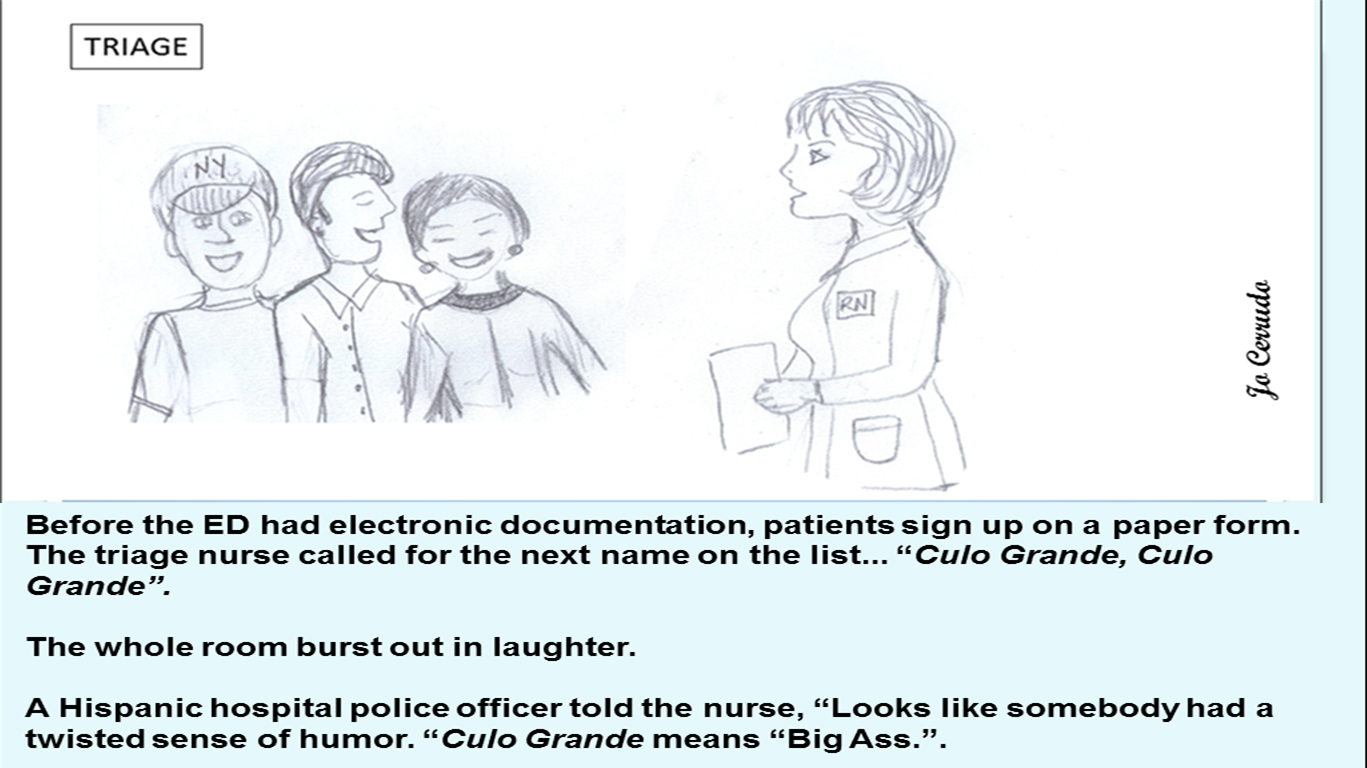
Before the ED had our electronic documentation, patients sign up on a paper form. Liz, the triage nurse, loudly called for the next name... “Culo Grande, Culo Grande”. Nobody responded, and instead most of the patients were grinning, some with chests heaving with laughter every time Liz called out the name.
A Hispanic hospital police officer sidled up to Liz, “Do you know what ‘Culo Grande’ means?” It means “Big Ass.”.
Liz refused to triage after that.


@@@

Do you know you can get drunk just from breathing the off-gases from the patients in the ED on New Year’s Day?


@@@

Everybody knows CG, our resident drunk. He came via EMS, he came walking, he came in any which way he can especially on cold winter nights. He slipped in and out of the ER in sync with our mealtimes. Then he was gone for a month.
He came back one day, all cleaned up, dressed up in clean dress pants and shirt and a blazer. His sister got him into Rehab. We patted him on the back, even high-fived with him. “Way to go.”, “Keep it up”. TL smiled ear-to-ear, and blushed beet-red as he accepted all the compliments from the staff. We all felt that there was still hope in life.
A month later, he came back drunk and seizing.

@@@

The red EMS notification phone rings. All ED personnel stopped in their tracks and listened with bated breath. The triage nurse answers, “No, sir, this is not a pizza parlor.”


@@@

Everybody gasped. On the endoscopy machine screen, the patient’s stomach lining was littered with debris of her experiments with exotic food: an eraser, a paper clip, a teaspoon, a capped syringe, and a ring.
The GI consultant exclaimed, “So, that’s where my wedding ring went!”.

@@@

The medical intern volunteered to do the chest compressions during a code. The strong, even strokes reflected on the defibrillator screen. Then the compressions became weaker, slower until the intern dropped on the floor.
Somebody said, “Uh-oh, there’s still Nitropaste on the patient’s chest.”